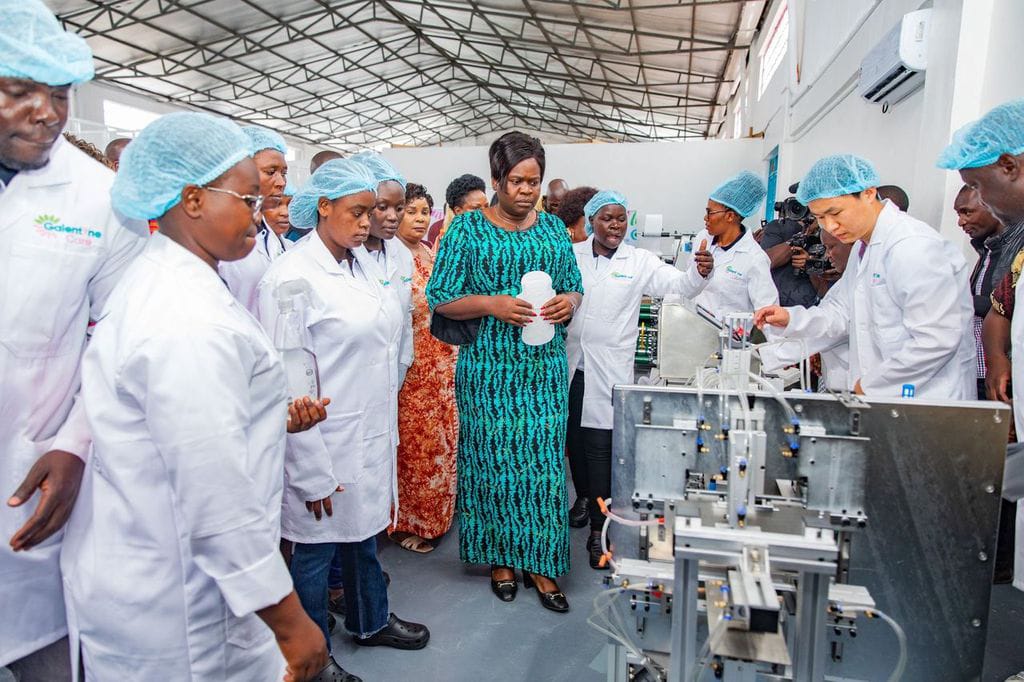
An all women led sanitary pad factory has been launched in Homa Bay County, a move expected to cut the cost of menstrual products and create jobs for local women.
The Galentine Care sanitary pad factory was officially opened in Kasgunga Ward, Suba North, by Gladys Wanga together with development partners. The facility targets period poverty, a challenge county leaders link to school absenteeism, vulnerability, and household hardship.
Speaking at the launch, Governor Wanga said period poverty cannot be separated from education and income struggles.
“This is not charity. It is a social enterprise rooted in dignity,” said Governor Wanga.
She said when girls lack access to pads, they miss school and become exposed to risk.
“When girls lack access to pads, they miss school. When they miss school, they become vulnerable,” she noted.
The governor added that the new factory offers a practical response rooted in dignity and work.
The factory will manufacture sanitary pads made by women for women and sell them at prices up to sixty percent lower than current market rates, with packs going for as low as fifty shillings.
The launch comes as Homa Bay County continues to record the highest teenage pregnancy rates in the country. County data shows more than seventeen thousand teenage pregnancies were reported in 2024, about twenty two percent of all pregnancies. By mid last year, more than ten thousand new cases had already been recorded.
Suba North MP Millie Mabona said the project shows how local investment can protect girls and strengthen the economy.
“No girl should miss school because of her period. This factory is proof that when we invest locally and legislate smartly, we can protect dignity, create jobs and secure the future of our girls,” said Hon. Millie Mabona.
Galentine Care founder and CEO Peter Macodida said community research carried out in Homa Bay showed that ninety seven percent of women could afford pads priced at fifty shillings.
“Women told us clearly, the barriers were cost and last-mile access. That insight shaped everything. This factory proves that market-based solutions can deliver dignity at scale,” added Macodida.
Co founders Stephanie March and Tracy Mackavin said women led manufacturing makes economic sense and helps communities grow by keeping girls in school and creating employment.
“Galentine Care is not just a factory, it is a movement. When women are given the tools and trust to lead, communities thrive,” said Tracy Mackavin.
“When women design solutions for their own lives, the impact is powerful. Galentine Care is proof that women-led manufacturing can create jobs, keep girls in school and build thriving communities. This is what investing in women truly looks like,” shared Stephanie March.
Jane Anyango, Director of Polycom Girls, said the project grew from years of community work and school pad banks.
“This factory is the fulfillment of a long-held dream. At Polycom Girls, we started with pad banks in schools because we saw firsthand how period poverty holds girls back. With Galentine Care’s factory here in Homa Bay, we are building a future where girls stay in school, participate fully and pursue their passions without shame or interruption,” asserted Anyango.